

ECOMORE Network Held its Administrative Regional Kick-Off Meeting
On 3 December 2025, the ECOMORE Network held its Regional Kick-Off Meeting, marking the official start of its activities embedded within the Health Security Strengthening in the Indo-Pacific Region (SSIP) Project, funded by the Agence Française de Développement (AFD) and by the Institut Pasteur (Paris).
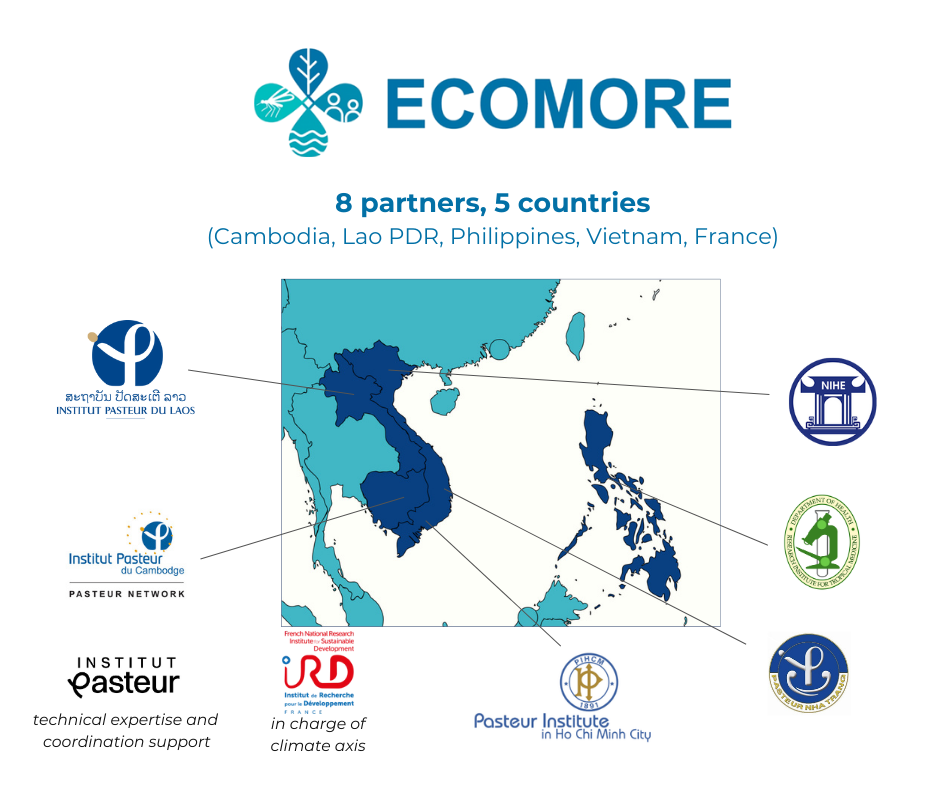
In South-East Asia, the ECOMORE Network aims to strengthen health security in Southeast Asia through an integrated One Health approach, focusing on the circulation of major zoonotic and vector-borne diseases. The project combines advanced diagnostic tools, environmental and climatic data, and vector/reservoir studies to better understand transmission dynamics. Under the coordination of the Institut Pasteur (Paris) and the Institut Pasteur du Cambodge, this network is composed of 8 research institutes in 5 countries : the Institut Pasteur du Cambodge, in Cambodia; the Institut Pasteur du Laos (IPL), in Lao PDR; National Institute for Hygiene and Epidemiology (NIHE), the Institut Pasteur Nha Trang (IPNT), the Pasteur Institute of Ho Chih Minh City (PIHCMC), in Vietnam; the Research Institute for Tropical Medicine (RITM) in the Philippines; the Institut de Recherche pour le Développement (IRD), on climate aspects, and the Institut Pasteur (Paris).
Partners gathered online to review the project’s objectives, planned activities, and upcoming milestones across the four technical axes, Laboratories, Climate & Health, Surveillance and Response. The meeting also introduced the ECOMORE Communication Plan, Gender Action Plan, and Indo-Pacific transversality component with two other regional health networks, respectively: One Health Epidemiological Surveillance and Alert Management (SEGA OH) in the Indian Ocean, and the Pacific Public Health Surveillance Network (PPHSN) within the Pacific Community (CPS).
The SSIP project, in collaboration, will focus on two core priorities: (i) strengthening integrated approaches to human, animal, and environmental health; and (ii) establishing a framework for inter-network cooperation on epidemic preparedness and response (PPR). The coordination teams and work package leaders highlighted the strong collaboration driving this initiative and reaffirmed their commitment to strengthening regional health security.